
RCM Strategy
How Dental Claim Errors Show Up as Redone Work, Not Just Rejected Paperwork
By Dr. Ammal Machnouk, Product and Success Lead · November 12, 2026
A rejected claim isn't only a billing task. It comes back to the chair as charts to pull, narratives to rewrite and clinical decisions to defend, months after the patient left.
You seated the crown in March. In June the claim comes back: no pre-operative radiograph, or a narrative the payer says doesn't support the need for a crown. Someone pulls the chart, and the question lands on you. Why a crown and not a large filling? You answer it from notes written three months ago, between two other patients.
That's what dental claim rejections really cost a dentist. The resubmission takes the front desk a few minutes. The clinical rework that comes with it takes your time, on the payer's schedule, not yours.
Rejected and denied are different problems, and both come back to you
Practices often use the two words interchangeably. The payer doesn't.
A rejection means the claim never reached review. It failed a basic check: an invalid subscriber ID, an outdated code, a missing field. You fix it and resubmit.
A denial means the payer reviewed the claim and said no. Missing attachments, frequency limits and documentation that doesn't support the procedure all end here. Overturning it takes records, often a narrative, and sometimes a formal appeal.
Both usually start the same way: an error made when the claim was put together.
Where dental claim rejections start
Most of the reasons are mundane. A dental clearinghouse's list of the most common rejection reasons includes codes that weren't updated, invalid subscriber IDs, subscribers the payer can't find, missing patient information, wrong addresses and duplicate claims. Add the clinical side and the full list looks like this:
Codes that weren't updated for the new year. The ADA updates CDT codes every year, and claims using a deleted or changed code fail.
Patient and subscriber details that don't match the payer's records. A transposed ID, a maiden name, an old address.
Provider details that don't match credentialing. The wrong billing or rendering NPI, or a tax ID the payer has on file under a different location.
Missing dental claim attachments. Radiographs, periodontal charting and narratives for crowns, scaling and root planing, and buildups.
Narratives that describe the procedure instead of the reason for it. "Crown recommended" tells the payer nothing it can approve.
Duplicate submissions. The same claim sent by mail and electronically.
Why it keeps happening in well-run practices
None of this means the front desk is careless. The errors come from the way the work is set up.
Information gets typed more than once. Patient details move from the intake form to the practice management system, to the clearinghouse, to a payer portal. Every manual step is a chance for a mismatch.
Payer rules live in people's heads. The coordinator who knows one payer wants a narrative on every crown leaves, and the next claims go out without one.
Documentation habits differ between providers. One dentist charts the fracture line and how much tooth structure is left. Another writes "crown needed." The second chart produces more denials, even when the clinical decision was identical.
What claim rework actually costs
There's little published research on dental claim rework specifically, so the best-known figures come from medical billing. The mechanics are the same.
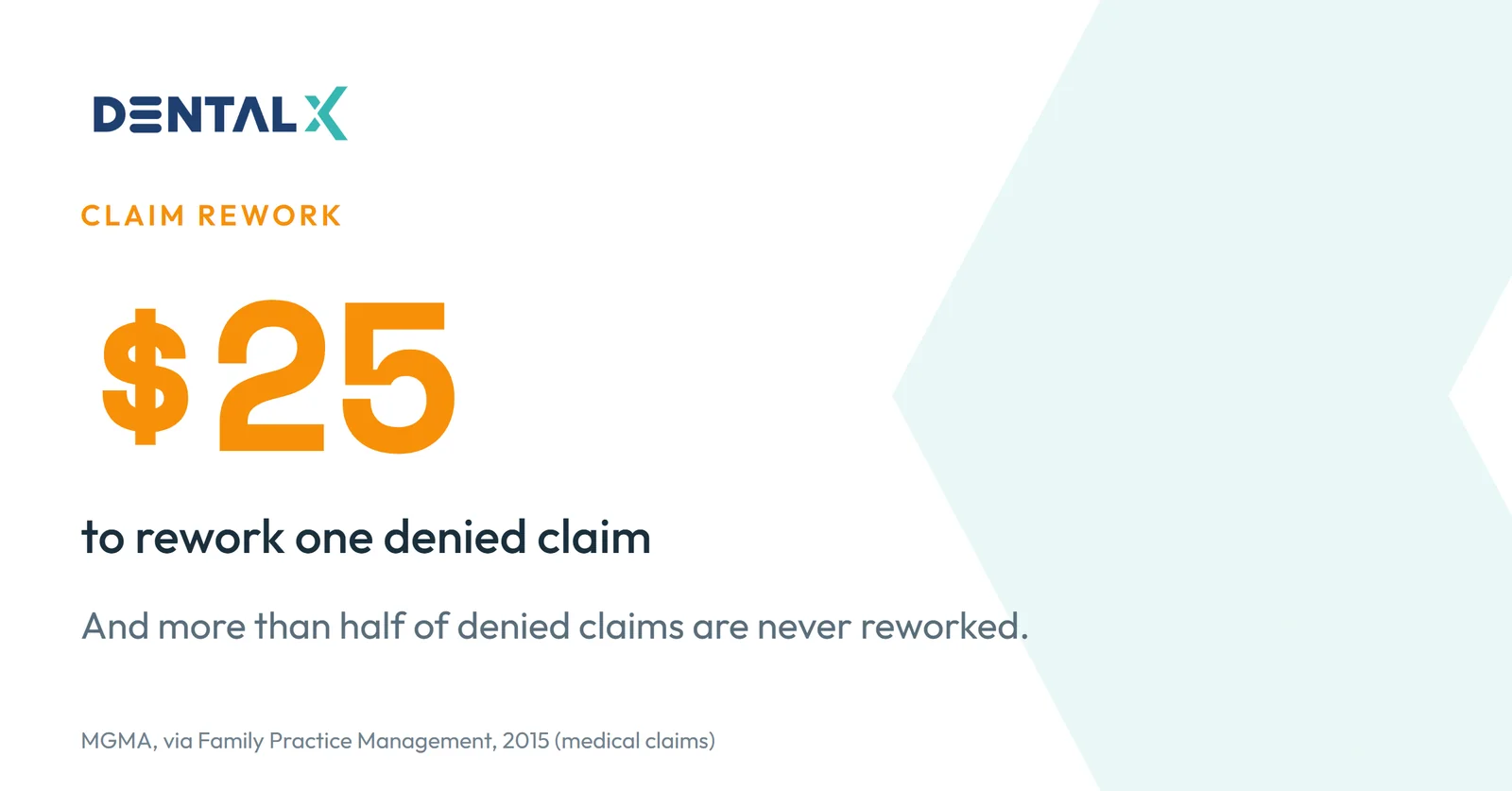
The Medical Group Management Association put the cost of reworking a denied claim at about $25, and found that more than half of denied claims are never reworked at all (Family Practice Management, 2015).
Change Healthcare's 2020 Denials Index, based on hospital claims, put the cost of working a denial at $25.20 per claim and found that 86% of denials were potentially avoidable (Becker's Hospital Review).
Submission itself isn't the bottleneck in dentistry. The CAQH Index 2024 found 90% of dental claims are already submitted fully electronically. The cost sits in what happens after a claim goes out wrong.
None of those figures counts the dentist's time. Ten minutes rebuilding a narrative is ten minutes not spent with a patient.
How to raise your clean claim rate before claims leave the office
You don't need new software to cut most of this. You need a few habits that run every day.
Update codes and fees every January, before the first claim of the year goes out.
Check subscriber details at every visit against the current card and eligibility response, not last year's record.
Set an attachment rule for each procedure. For example: crowns go with a pre-operative radiograph and a narrative; scaling and root planing goes with current periodontal charting and radiographs; buildups go with a radiograph showing the remaining tooth structure. Check each payer's specific requirements.
Write narratives that answer the payer's question: which tooth, what condition, and why a less extensive treatment won't work. "Tooth #19: fractured distolingual cusp under a large MOD amalgam, recurrent decay at the distal margin, roughly 60% of coronal tooth structure lost. A direct restoration would not restore function or cuspal protection." That narrative can be approved. "Crown recommended" can't.
Read the rejection report the same day. A rejection that sits becomes a timely filing problem.
Track rejections by reason for one month. If one reason accounts for most of them, it's a process to fix, not a run of bad luck.
How Dental-X catches claim errors before the payer does
Claims checking works best before submission, not after. Software can check each claim against the payer's rules, including codes, IDs and the attachments that payer requires for that procedure, and hold the ones that would fail before they go out.
Dental-X checks claims for missing radiographs and narratives before submission. For complex cases, our specialists attach radiographs and write clinical narratives, so the clinical rework doesn't land back on you. Results write back into your practice management system, so your team never works from two screens.
The same principle applies further upstream. Fixing errors at eligibility, before the claim exists, is how a 19-practice DSO recovered $2.4M in 90 days with Dental-X.
Questions practices ask about dental claim rejections
What's the difference between a rejected and a denied dental claim?
A rejected claim failed a basic check, such as an invalid subscriber ID or outdated code, and never reached the payer's review. You correct it and resubmit. A denied claim was reviewed and refused, and overturning it usually takes records, a narrative or a formal appeal.
What are the most common reasons dental claims get rejected?
Outdated CDT codes, subscriber IDs that don't match the payer's records, missing patient information, wrong addresses and duplicate submissions. On the clinical side, missing radiographs and narratives that describe the procedure rather than the reason for it.
How quickly should a rejected dental claim be fixed?
The same day the rejection report arrives, if possible. A rejected claim was never received by the payer, so every day it sits uses up the timely filing window, and limits vary by payer and plan.
How many of your claims come back for something preventable?
Dental-X AI is the Revenue Recovery platform that finds and recaptures the money leaking out of your insurance workflow, and proves it in recovered dollars.
Find out what your practice is leaving with the payers.
A Leakage Audit shows you where the revenue is going, before you commit to anything.