
RCM Strategy
Dental Year-End Checklist: 5 Things to Close Before December 31
By Dr. Ammal Machnouk, Product and Success Lead · November 5, 2026
January 1 resets maximums and deductibles on most dental plans. It doesn't reset your A/R. Here's what to close first, and the payer rules that decide whether it pays off.
On January 1, most of your patients' dental plans start over. Annual maximums refill, deductibles reset, and whatever a patient didn't use this year is usually gone.
Your A/R doesn't start over. A claim that's been sitting since August is still sitting there in January, just closer to its filing deadline and harder to collect.
So December is two jobs at once: help patients use the benefits they've paid for, and close out the money payers still owe you. This is the dental year-end checklist we'd work through, with the rules that trip each item up.
1. Book patients who still have benefits to use
Start with a list of patients who have unscheduled treatment and remaining annual maximum. A patient who has already met this year's deductible pays less for the same procedure in December than in February, when the deductible starts again.
Four things to check before your team picks up the phone:
When does their plan year end? The maximum resets at the start of the plan year, which is often January 1 but not always. Delta Dental of Iowa notes that a benefit period can start at different points in the year.
Can the treatment finish this year? Payers count multi-visit work on the completion date. For crowns, bridges, inlays and onlays, that's the cementation date, per Delta Dental of New Jersey. A crown prepped December 28 and seated January 9 comes out of next year's maximum.
Does a frequency limit get in the way? Plans write frequency limits per year, per 12-month period, or as a minimum gap between visits. A cleaning booked in late December can still be denied under a time-between-visits rule.
Does the plan roll anything over? Some plans carry part of an unused maximum into the next year, such as Guardian's Maximum Rollover. Check before telling a patient their benefits will "expire."
Patients with a health FSA have a second deadline. Unused FSA money is generally forfeited at the end of the plan year. The exceptions: the employer can offer a carryover (up to $680 from 2026 into 2027, under IRS Revenue Procedure 2025-32) or a grace period of up to 2½ months, but not both. WEX explains the rule. That's a reason to mention it on the call, not a promise. The patient's employer decides.
2. Chase claims older than 90 days now, not in January
A claim with no payment after 90 days isn't slow. It's usually stuck: lost at the payer, pended for information nobody sent, or denied in a letter nobody opened. Every week it sits, the filing deadline gets closer.
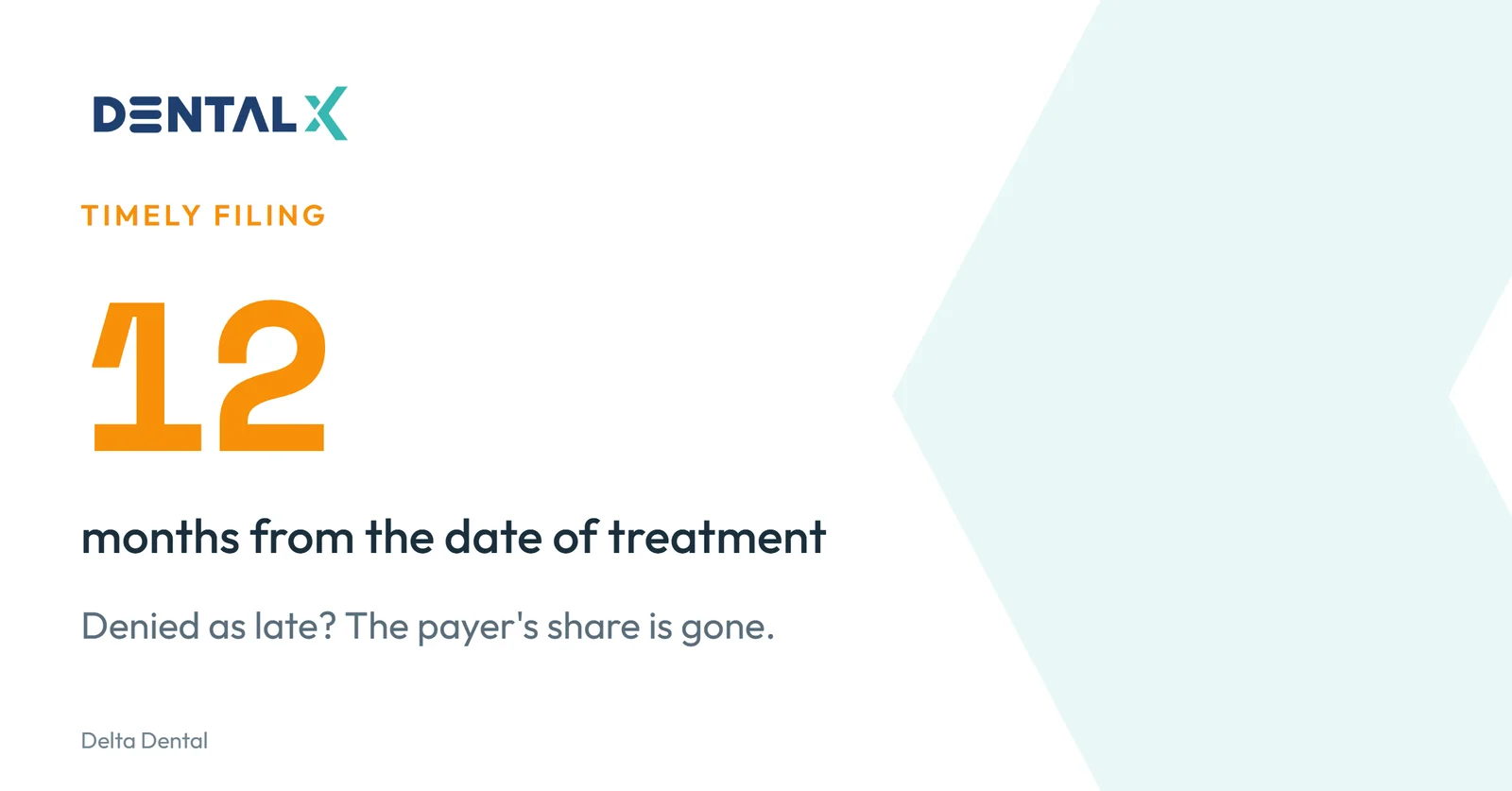
That deadline is real money. Delta Dental states that claims received more than 12 months after the date of treatment may not be paid, and some programs set shorter limits. When a claim is denied for late filing, the patient owes only their cost share. The payer's portion is gone.
Before December 31:
Pull every open claim older than 90 days, and every claim from late 2025 that's nearing a 12-month limit.
Check each one's status with the payer and write down why it's stuck.
Resend anything the payer has no record of, with proof of the original submission.
Answer every request for information, then follow up until the claim moves.
Then change the trigger for next year. A claim with no response after four weeks is already telling you something. Catch it at 30 days and you still have months of filing window, not weeks.
3. Match every EOB to a bank deposit
A posted EOB and a bank deposit are two halves of one payment. When they don't meet, you get one of two problems. Either money sits in the bank that the ledger never heard about, so the claim stays open and someone chases a payer that already paid. Or a payment was posted that never arrived.
For electronic payments, the match is built in. Under the CAQH CORE EFT and ERA reassociation rule, the electronic remittance and the EFT carry the same trace number. The rule also says payers should release the remittance no more than three business days before or after the payment's effective date. If a deposit has had no remittance for longer than that, ask the payer for it.
Your December close:
Every December deposit tied to an EOB or ERA
Every posted insurance payment tied to a deposit
Paper checks and mailed EOBs matched by hand, since they don't carry the electronic trace number
Short deposits checked against the remittance, which can show an offset the payer took for an earlier overpayment
4. Rework denials while the clock still allows it
Denials pile up in December because everyone's focused on the schedule. Each one has its own clock: the payer's window for a corrected claim or an appeal. Those windows come from each payer's provider manual and your contract, so look them up rather than assuming the original filing limit applies.
Sort the open denials into three piles:
Admin errors (wrong subscriber ID, missing tooth number): correct and resubmit.
Missing documentation (X-ray, perio chart, narrative): send what the payer asked for.
Coverage denials (frequency, maximum reached, not a covered benefit): decide whether to appeal or move it to the patient's balance. Tell the patient before the statement goes out.
Then look for patterns. If one payer denied three crowns this year for a missing narrative, that isn't three denials. It's one payer rule your team hasn't written down yet.
5. Plan January's eligibility re-checks before January
The first week of January is when verification breaks. Deductibles reset, maximums refill, and some patients start the year on a new employer plan or a new carrier. A verification from November tells you very little about a January 6 appointment.
Re-verify every January appointment against the new plan year, not only new patients.
Ask for the current insurance card when you confirm the appointment, not at check-in.
Expect estimates to rise. With the deductible back, the patient's share of the same procedure goes up in January.
Check coverage at the procedure-code level. An active plan doesn't mean today's procedure is payable.
What is December costing you?
Most of this list is the same work you do every month: finding claims that stalled, matching payments to what was owed, and checking coverage before the patient sits down. December just puts a date on it.
Dental-X AI is the Revenue Recovery platform that finds and recaptures the money leaking out of your insurance workflow, and proves it in recovered dollars.
Find out what your practice is leaving with the payers.
A Leakage Audit shows you where the revenue is going, before you commit to anything.
Sources
Claim | Source |
Annual maximum resets at the start of the plan year, not always January 1 | |
Crowns, bridges, inlays and onlays are dated on the cementation date | |
Some plans roll part of an unused maximum into the next year | |
Health FSA carryover up to $680 from 2026 into 2027 (Rev. Proc. 2025-32) | |
FSA use-or-lose; carryover or grace period of up to 2½ months, not both | |
Claims received more than 12 months after treatment may not be paid; if denied as late, the patient owes only their cost share | |
ERA and EFT share one trace number; ERA released within three business days of the EFT date |