
Payments & Collections
How a 19-Location DSO Put $4.6M in Payments on Autopilot
By Dr. Ammal Machnouk, Product and Success Lead · September 23, 2026
A 19-location DSO’s four-person team was posting every insurance payment by hand. The real cost wasn’t the manual work — it was the payer and location insight buried in every remittance that nobody had time to read for.
If you run more than a handful of locations, you know the shape of month-end. Everything holds together — until someone’s out. Then the team that was already keeping pace loses its margin, and the last few days of the month turn into a scramble to catch up before close.
A 19-location DSO ran its insurance payment posting on exactly that margin. Four people opened every remittance, matched it to a claim, and keyed it into the ledger by hand across 19 locations. It worked, in the sense that every payment eventually got posted. But "eventually" depended on nobody being out, and someone always eventually is.
The scramble wasn’t the real cost
Posting payments by hand touches every claim several times over: someone opens the remittance, matches it to the right claim at the right location, keys the payment into the ledger, and chases the ones that don’t match cleanly. At 19 locations, that’s thousands of remittances landing on four desks every month — which is exactly why one absence was enough to turn month-end into a scramble. There was no slack built into the schedule to absorb it.
But the bigger cost wasn’t the scramble. A remittance carries more than a payment — it shows what a payor actually paid against, and why. Reading it just long enough to post it meant that detail disappeared the moment the payment was keyed in. Nobody had time to ask which payors were driving denials, or which locations were falling behind.
Nobody was behind because they were bad at the job
Four people can’t manually post that volume, absorb every absence, and still have time to read what the data underneath it was showing. The math doesn’t close, no matter how good the team is. The fix wasn’t more hands — it was taking the reading and keying out of anyone’s hands at all.
What changed: the reading became automatic, not just the posting
Every remittance gets downloaded and read without a person opening the file. The system pulls the EOB, extracts what the payer actually paid, and reads it the same way a person would — just without the person.
Matching and posting happen the same day the payment lands. A claim that resolves cleanly posts straight through, with no one keying in a line item.
Exceptions land in a queue with a reason attached, not a pile with none. A patient the system can’t match, a claim number that doesn’t resolve, a code mismatch — each one routes to a queue the team can actually work, instead of stalling with no explanation.
"I used to open every single remittance myself. Now I only see the ones that actually need me — and I can tell you exactly why each one is there instead of guessing."
— Support Manager, Administration, 19-location DSO
What came back
$4.58M in insurance payments posted automatically across roughly five months, with no manual entry.
A 95.0% straight-through rate — of every claim eligible for automated posting, the large majority posted without a person touching them.
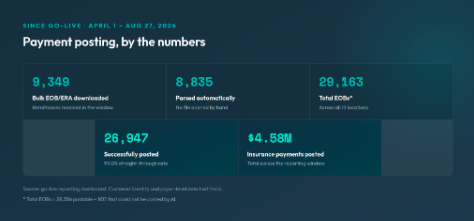
Figures from the go-live reporting dashboard, April 1 – Aug 27, 2026. Customer identity and payer-level detail withheld.
94.5% of remittances parsed without a file ever being opened by hand — the remainder flagged for manual review rather than silently skipped.
Aged claims got worked for the first time. With posting off their plate, the team opened the Aged Claims report — something the schedule had never had room for — and started working it.
And the payer and location detail came back. The same information that used to disappear the moment a payment was posted now shows which payors are driving denials and which locations are falling behind.
The team didn’t get smaller. The job changed.
The posting team is still four people. What’s different is what fills their day. Instead of opening every remittance and keying in every payment, they work the exception queue — and, for the first time, the Aged Claims report that used to sit untouched. Adding a location doesn’t mean adding headcount anymore; it means one more feed into a process that already runs itself.
What’s your payment posting actually costing you?
If your team is still opening every remittance by hand, the scramble at month-end isn’t a staffing problem — it’s a sign the process was never going to scale with your locations in the first place. And the scramble is the visible cost. The invisible one is everything in that remittance nobody has time to read: which payors are quietly costing you, and which locations need attention before it shows up in your A/R.
Dental-X AI is the Revenue Recovery platform that finds and recaptures the money leaking out of your insurance workflow, and proves it in recovered dollars.
Find out what your practice is leaving with the payers.
A Leakage Audit shows you where the revenue is going — before you commit to anything.