Eligibility & Verification
Ten Seconds to Know If Today's Appointment Will Get Paid
By Nupur Aggarwal, CPO · August 26, 2026
How Whiter Family Dentistry moved from active-or-not eligibility to procedure-level validation — without disrupting the front desk — and grew EBITDA ~15%.
There is one question a front desk needs answered before a patient sits down: is the work scheduled today actually going to get paid for?
Most practices can't answer it quickly. They can confirm a plan is active in seconds — but that is a different question, and the gap between the two is where the write-offs come from.
Dr. Jacob Witer's team was living in that gap. Whiter Family Dentistry was already running bundled RCM tools inside its practice management system. On paper, eligibility was being verified. In practice, his team was on the phone with payers every morning and claims were still going out wrong.
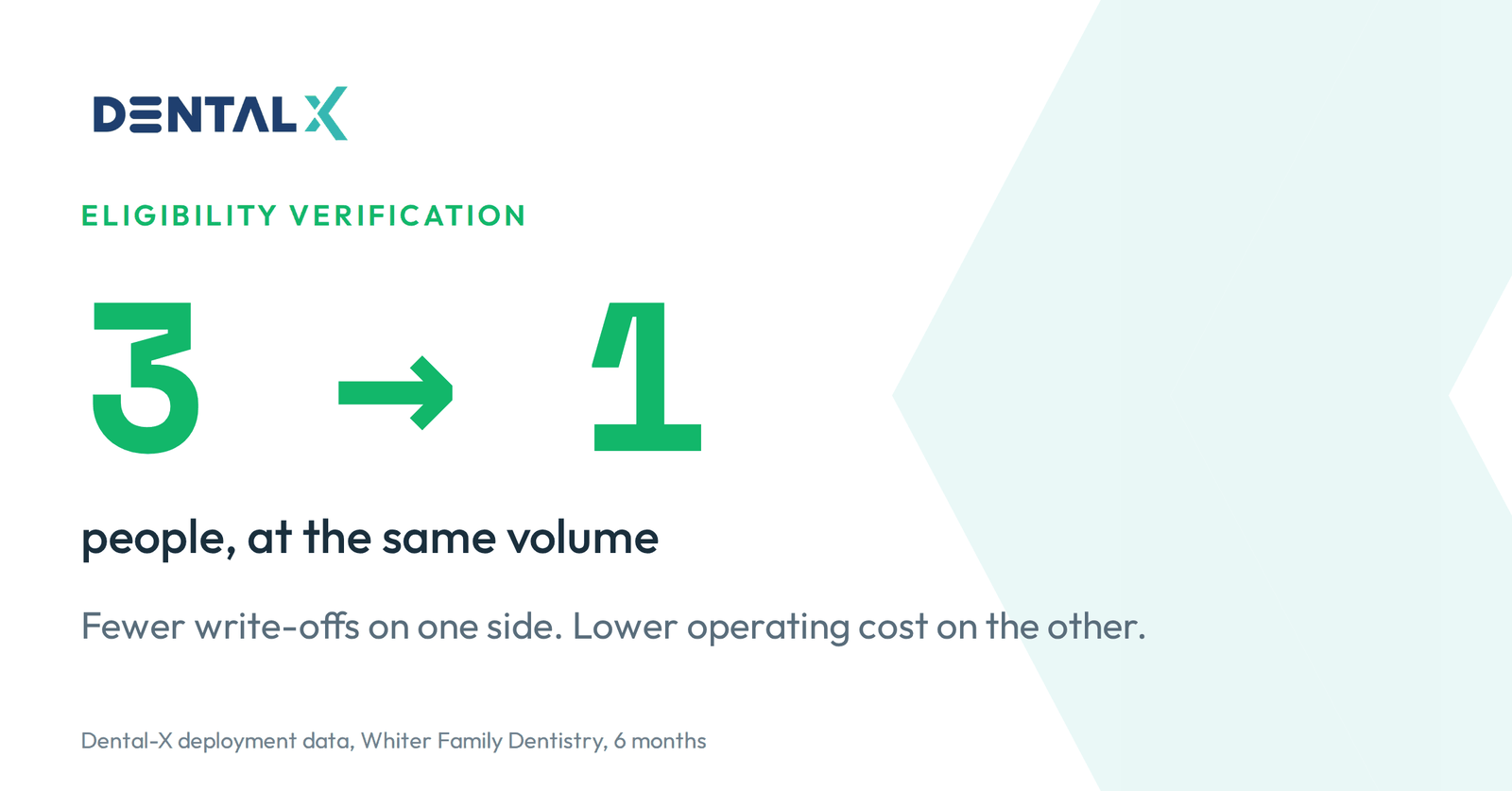
Six months after deploying Dental-X, verification took one person instead of three and EBITDA was up ~15%.
What the bundled tools said they were doing
Active-or-not is a yes-or-no, and it is genuinely useful. It is just not what a claim gets adjudicated against. What the front desk could not see, without picking up the phone, was everything that actually determines whether the practice gets paid:
Whether the specific procedure is covered under that plan
What frequency limitation applies
How much of the annual maximum is already spent
Whether a waiting period is still running
Which plan-specific exclusions are in play
So treatment plans were built on partial coverage data. Patients were quoted numbers that moved later. Claims went out clean-looking and came back denied, and the write-off was decided weeks after anyone could do something cheap about it.
Why that lands in EBITDA, not just in A/R
A shallow eligibility check costs a practice on both sides of the margin at once. On the revenue side, work gets performed against coverage that was never going to pay for it, and that becomes a write-off — revenue already earned, already delivered, never collected. On the cost side, somebody has to make up the difference manually. At Whiter Family Dentistry that meant three people working eligibility verification, largely on hold with payers.
That is why the number Dr. Witer watched was EBITDA rather than collections. Fix the check and both sides move.
An onboarding that didn't cost them a month
The reason most practices stay on tools they have outgrown is switching risk. Ripping out a workflow the team knows, mid-quarter, with patients still walking through the door, is a real operational hazard — and every vendor promises it will be painless.
Dental-X was deployed into the practice's existing workflow rather than over it. Nothing was torn out on day one. A dedicated Customer Success Manager and a Customer Engineer worked as an extension of the team, and every milestone landed on time and in scope.
Training was hands-on and unhurried, which mattered more than it sounds. When new software arrives at a front desk, the unspoken question is whether it is here to help or to replace someone. Positioning Dental-X as a daily utility — something the team runs, not something that runs them — is what turned adoption from a negotiation into a non-event.
What the team sees before the patient sits down
The difference is not that Dental-X verifies faster. It is that the screen answers three questions at once, and the third one is the question a status check never reaches.
Is the plan active?Top strip — coverage status, effective date, primary or secondary, in or out of network.
Can this patient afford today?Remaining annual maximum, remaining deductible, and the coinsurance split across preventive, basic and major — including what the patient owes on each.
Is the work scheduled today actually payable?Every code on today's appointment, checked against this plan's own rules.
Here is a clean one. Every procedure on the schedule is covered at 100%, the deductible is met and waived for preventive anyway, and there is $642 left on the annual maximum. Nothing to do.
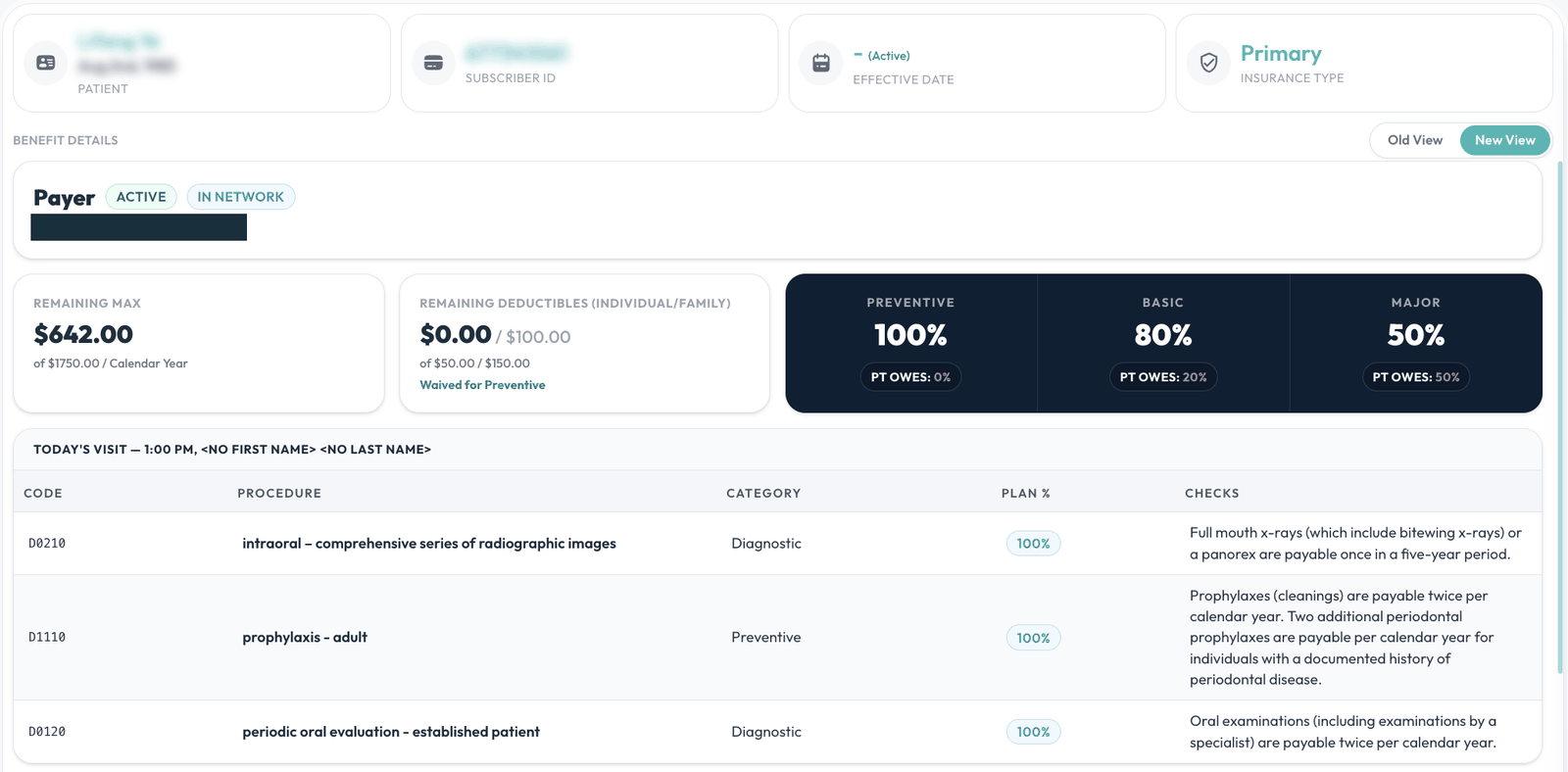
The value is that this took about ten seconds to establish, and no phone call. Under the old workflow, producing that same certainty meant someone on hold with the payer, reading codes down the line.
Now the same screen when something is wrong.
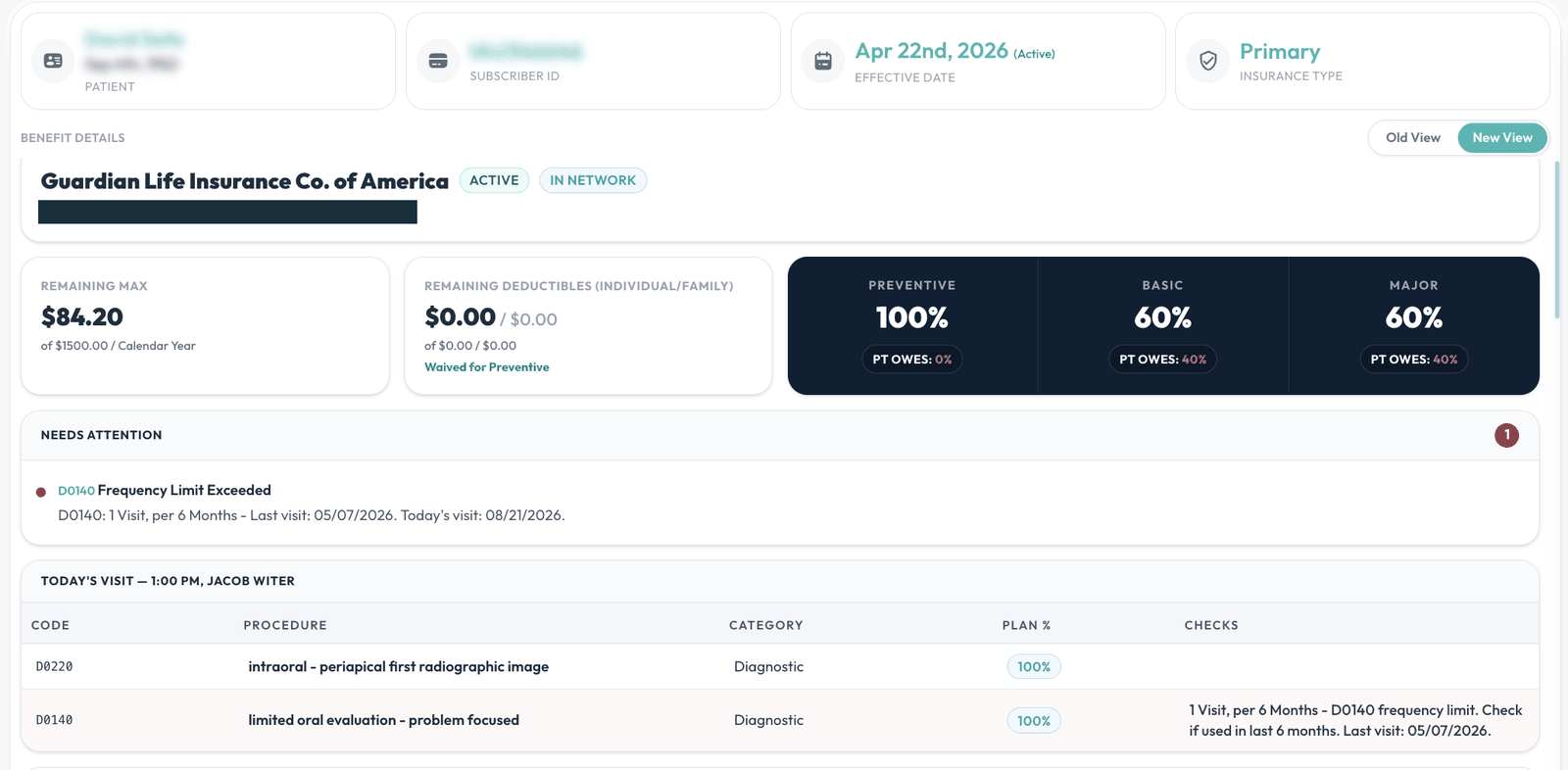
Two things are visible before the patient arrives. A Needs Attention flag on D0140 — the plan allows one limited oral evaluation per six months, and this patient had one in May. Submit it today and it comes back denied. And the annual maximum is down to $84.20 of $1,500, which means anything beyond preventive work in the rest of this calendar year is coming out of the patient's own pocket.
Both of those are conversations that now happen before treatment instead of after a claim. That is the whole difference between a write-off and a decision.
The plan, not just the patient
Behind the appointment view is the full coverage map — every procedure group the plan touches, by specialization, with the class, the plan percentage, the frequency rule in the payer's own words, and a plain status: eligible, limit met, or not covered.
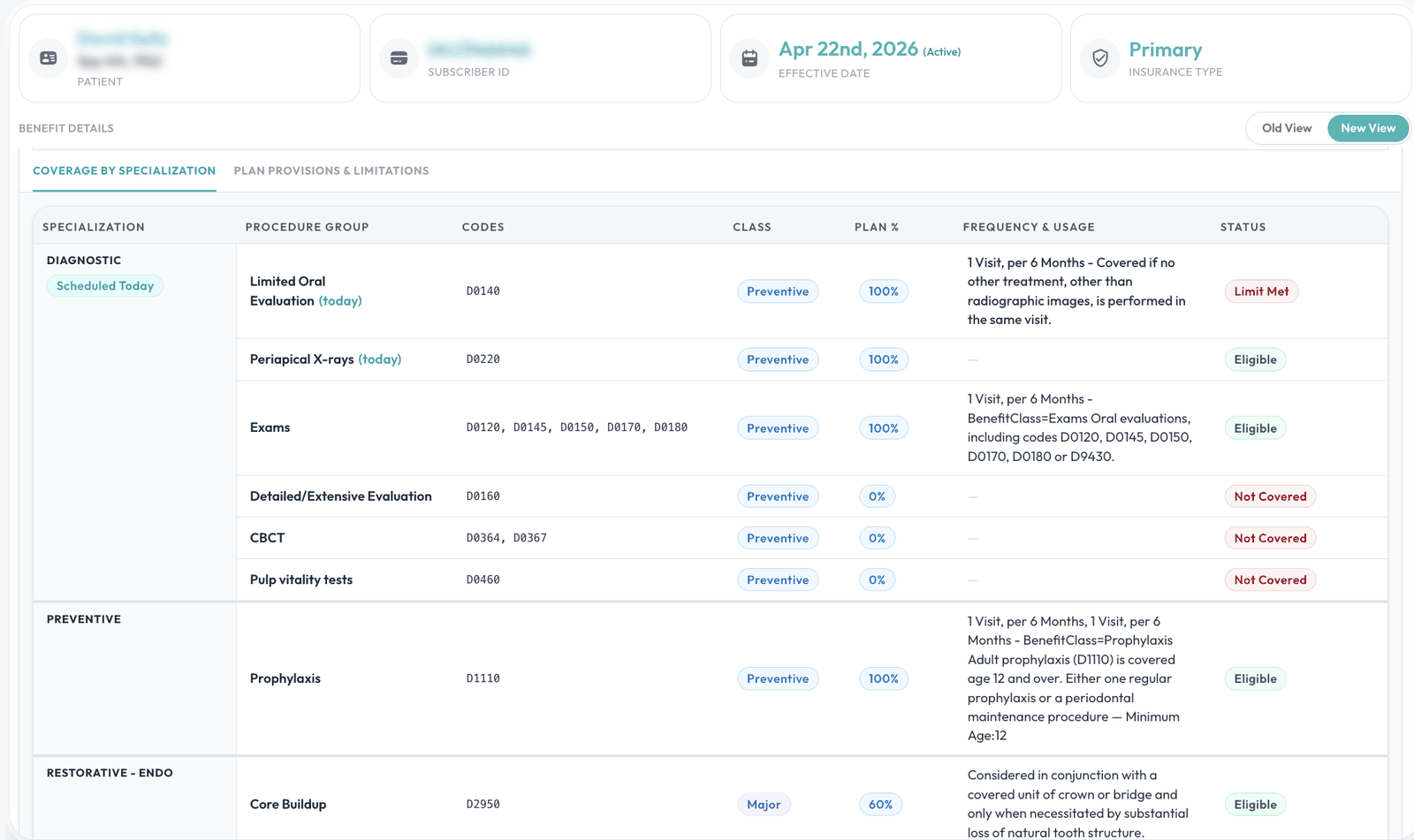
This is what a verification call used to produce, one answer at a time, and then lose the moment the call ended. Now it is standing data the whole team can read — so the treatment plan a provider builds and the estimate the front desk quotes come from the same place.
Coverage is analyzed per location, too, because a practice in one neighborhood does not carry the same payer mix as a practice in the next.
Why that shows up in the numbers
Follow the two screens through to the P&L and both of Dr. Witer's results stop being surprising.
The staffing change.What consumed three people was never the looking-up — it was the calling. Replace the call with a screen that is already populated, and one person covers the same volume, escalating only what gets flagged.
The margin change.Every flag like that D0140 is a denial that never happened, and every remaining-maximum figure surfaced early is a patient conversation instead of an aged balance. Fewer write-offs, lower operating cost, at the same patient volume — which is EBITDA moving from both directions at once.
What six months changed
EBITDA up ~15%, driven by fewer write-offs and lower operating cost rather than by seeing more patients.
Eligibility verification down from three people to one, at the same volume.
Treatment planning built on real coverage data, so patient estimates hold.
Where the confidence comes from
Verification data is patient data, so the security posture is not a footnote. Dental-X is HIPAA, GDPR and SOC 2 compliant, and ISO 27001 aligned.
What is your eligibility check actually telling you?
If your team confirms coverage is active and stops there, the write-offs at the end of your quarter are not a collections problem. They were decided at the front desk, weeks earlier, by a check that answered a smaller question than the claim would be judged on.
Dental-X is the Revenue Recovery platform that finds and recaptures the money leaking out of your insurance workflow, and proves it in recovered dollars.